

Setting Up Your First Smart Contract for Vendor Payments
A step-by-step walkthrough of deploying a basic payment contract. Covers wallet setup, contract deployment, and initial configuration.
Read ArticleUnderstanding conditional logic and event-driven payments in smart contracts


By
Editorial Team
Written by the ChainFlow Payments editorial team, focused on practical, clear guidance for blockchain-triggered vendor payments.
Smart contracts aren't magic. They're just instructions that run automatically when certain conditions are met. Think of it like a vending machine—you insert money, press a button, and the machine automatically dispenses your snack. No human needed to reach inside and hand it to you.
Blockchain triggers work exactly the same way. A trigger is an event or condition that tells a smart contract to execute a payment. When you set up a vendor payment system with triggers, you're essentially saying: "When X happens, automatically send Y amount to vendor Z." It's efficient, transparent, and removes the need for manual processing steps.
At their core, blockchain triggers use conditional logic—basically a series of "if this, then that" statements. You'll write rules like "if the delivery is confirmed, then release payment." The contract checks these conditions constantly. When all conditions are met, the trigger fires and the payment executes automatically.
Let's say you're paying a supplier for goods. The traditional approach? You manually verify the shipment arrived, check the invoice, confirm the amount, and then authorize payment. That takes time. With triggers, you skip those manual steps. The contract automatically verifies everything on the blockchain and sends the payment the moment conditions are satisfied.
Most payment triggers use three core components. First, you've got the condition—what needs to happen. Second, you've got the data source, which feeds information into the contract. Third, you've got the action—what happens when the condition is true. These three pieces work together. The data source continuously provides updates. The contract evaluates the condition. When it's true, the action executes. No delays, no intermediaries.
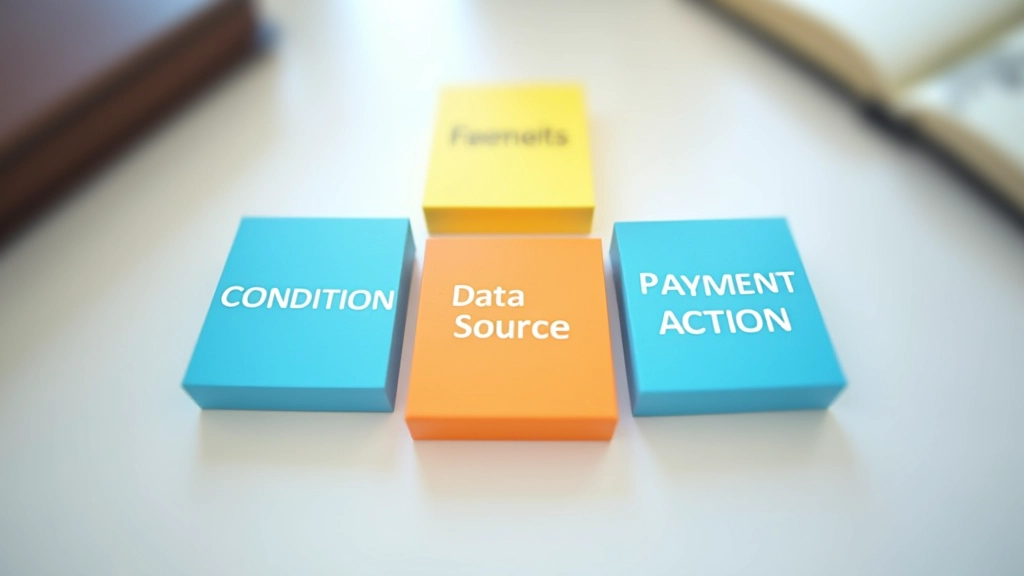

Different payment scenarios need different trigger types. You're not going to use the same trigger for a time-based payment as you would for an event-based payment. Here are the main categories you'll encounter.
Time-based triggers are the simplest. "Release payment on July 15th at 3 PM" is a time-based trigger. It's useful for recurring payments—monthly retainers, subscription fees, that kind of thing. The contract checks the date and time, and when they match, it fires automatically. You don't need external data feeds. The blockchain itself has timestamps.
Event-based triggers are more interesting. These fire when something happens on the blockchain. A delivery confirmation, a successful upload, a signature verification—any of these can trigger payment. They're more flexible than time-based triggers because they respond to actual business activities, not just a calendar date.
Oracle-based triggers pull information from outside the blockchain. Maybe you need to verify that the weather was sunny on a specific date, or that a particular stock price hit a certain level. An oracle—which is just a trusted data source—feeds that information into your contract. When the condition is met, the trigger fires.
Explore more about smart contract automation for vendor payments
A step-by-step walkthrough of deploying a basic payment contract. Covers wallet setup, contract deployment, and initial configuration.
Read Article
How to structure vendor agreements that work with automated payment systems. Build trust through transparency and clear payment schedules.
Read Article
Understanding regulatory requirements and legal frameworks for automated blockchain payments. Ensure your contracts comply with local regulations.
Read ArticleLet's walk through some practical examples. Say you're running a manufacturing business and you've got a parts supplier in another province. Normally you'd wait for the parts to arrive, verify the shipment, then process payment—maybe a few days later. With triggers, you can set it up differently.
You create a trigger that says: "When the shipment tracking shows 'delivered' and the parts are scanned into inventory, release 50% of the payment immediately. Release the remaining 50% after seven days if there are no quality issues." The contract monitors both conditions. When the first condition is met, it releases half the payment. The second trigger waits seven days. If no disputes are filed, it releases the rest. The supplier gets paid faster. You've got a safety window to verify quality. Everyone's happy.
Here's another scenario: a freelance project. You hire a designer for a website redesign. Normally you'd pay after delivery, but what if the work isn't up to standard? With a trigger-based system, you can set up milestone payments. First trigger: "When initial mockups are delivered and approved, release 30%." Second trigger: "When the full design is delivered and passes the review checklist, release 50%." Third trigger: "After two weeks with no reported issues, release the final 20%." This protects both you and the designer. They get paid incrementally as they deliver. You've got checkpoints to ensure quality.


The power of triggers is that you control the conditions. You're not stuck with pre-built templates. You decide what conditions matter for your business. This flexibility is huge, but it also means you need to think carefully about what you're setting up.
Start simple. Don't try to create a complex trigger system with fifteen different conditions on your first contract. Begin with one or two straightforward triggers—maybe a time-based payment and a simple verification event. Once you're comfortable with how the system works, you can build more sophisticated logic.
Consider what data is actually available to your contract. If you're setting a condition that requires external information, you'll need an oracle to provide that data. Oracles add complexity and cost. Make sure the benefit of having that condition justifies the additional expense. Also think about what happens if a condition never gets met. Does the payment stay locked forever? That's not great for vendor relationships. Build in fallback conditions or time limits so payments don't get stuck indefinitely.
Test your triggers before going live with real payments. Create test scenarios and verify that the contract behaves the way you expect. Check edge cases—what happens if two conditions try to fire at the same time? What if a data feed goes offline? These questions matter because once a payment executes on the blockchain, you can't reverse it.
Blockchain triggers aren't complicated once you understand the basic concept: conditions fire actions automatically. You set the rules. The contract enforces them. No intermediaries. No delays. No manual processing steps that slow down your business.
The real value comes from designing triggers that match your actual business processes. Don't force your workflows to fit the technology. Instead, think about where automation makes sense and where it saves time, reduces errors, or builds trust with vendors. That's where triggers shine.
Whether you're handling vendor payments, project milestones, or recurring subscriptions, the principle is the same. Define your conditions. Set your actions. Let the contract handle the execution. It's efficient. It's transparent. And it's becoming increasingly common for businesses that want to modernize their payment systems.
This article is educational only and is not financial advice. Cryptocurrency and blockchain technology involve significant risk. Smart contracts are still evolving, and deploying them requires careful consideration of security, legal implications, and regulatory compliance. Always consult with qualified professionals before implementing blockchain-based payment systems in your business.